Thursday, February 12, 2026
Your Security Inbox Is a Liability You're Not Managing

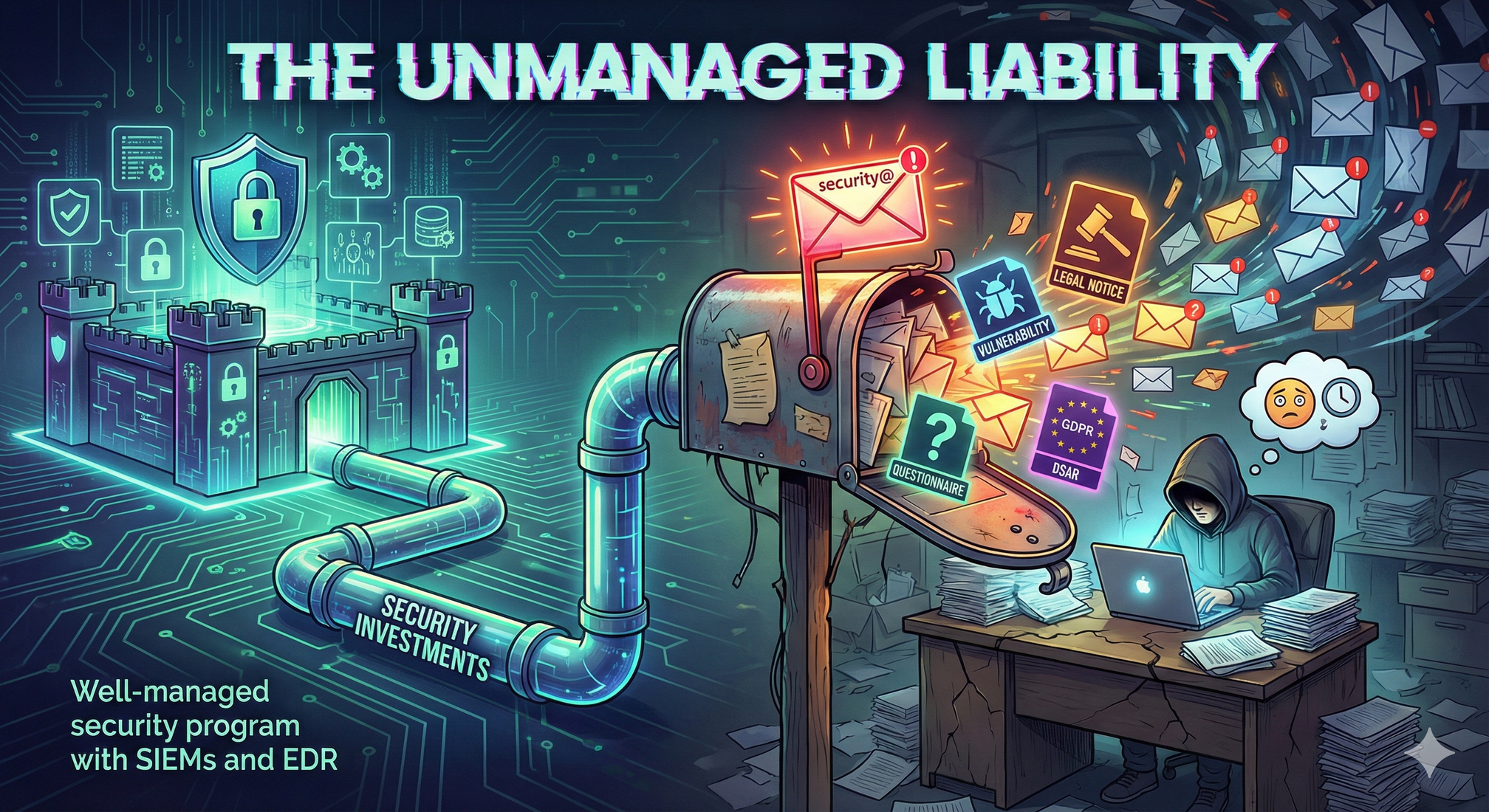
Most security programs have a blind spot, and it's hiding in plain sight: your security@ inbox.
You've invested in SIEMs, EDR, vulnerability scanners, penetration testing, and red team exercises. You've hired smart people, built incident response playbooks, and spent months getting SOC 2 certified. But the place where external vulnerability disclosures, legal notices, DSARs, compliance questionnaires, abuse reports, and breach notifications all land? That's usually a shared Gmail account that someone checks when they remember to.
I've spent years building infrastructure tooling and working with security teams across companies of all sizes. The pattern is remarkably consistent. The inbound security inbox is simultaneously one of the highest-risk communication channels in the organization and one of the least structured. It's where a zero-day disclosure sits next to a beg bounty sits next to a GDPR data subject access request with a 30-day statutory deadline - and someone has to open each one, figure out what it is, decide who should handle it, and hope nothing falls through the cracks.
This is a problem worth taking seriously. Here's why, and what can be done about it.
The hidden complexity of inbound security communication
When people think about the security inbox, they usually picture vulnerability reports. But the reality is much broader. A typical security@ address at a mid-to-large company receives a mix of at least a dozen distinct communication types, each with different urgency levels, different stakeholders, different compliance implications, and different response requirements.
Vulnerability disclosures need technical triage, severity assessment, and coordination with engineering. Security questionnaires from customers and prospects need input from compliance, legal, and sometimes engineering - and they're often blocking sales deals. Legal notices have statutory response deadlines. DSARs under GDPR must be acknowledged within 30 days. Abuse reports might need trust and safety. Pen test reports need the security team. Breach notifications from vendors need incident response.
All of these arrive in the same inbox. They look similar at first glance - they're all emails about security. But they require completely different workflows, different people, and different response timelines. And the consequences of getting it wrong range from an unhappy researcher to regulatory action.
Why this problem persists
There's a reason most security teams haven't fixed this. It doesn't fit neatly into any existing tool category.
Bug bounty platforms like HackerOne and Bugcrowd handle vulnerability disclosures well, but they don't touch questionnaires, legal notices, DSARs, or abuse reports. They're also designed around managed programs with curated researcher pools - if what you actually need is a structured VDP with optional bounties rather than a full managed program, you're paying for capabilities you don't use.
Ticketing systems like Jira can track anything, but they have no security context. They can't classify the difference between a critical vulnerability disclosure and a beg bounty. They can't auto-detect a legal notice or a DSAR. They require manual triage for every single message, which is the exact problem you're trying to solve.
Shared inboxes work until they don't. And they stop working at exactly the moment it matters most - when volume increases, when someone's on vacation, when an email arrives that looks routine but is actually a legal notice with a deadline, or when an auditor asks you to demonstrate your vulnerability disclosure process and you're reconstructing timelines from email threads and Slack messages.
The result is that most security teams end up with a patchwork: a shared mailbox, some Jira workflows, maybe a Slack channel for triage, manual forwarding rules, and institutional knowledge about who handles what. It works - until it doesn't.
The costs you're already paying
This isn't a theoretical problem. It has real, measurable costs that show up in three places.
People costs. Someone on your team - usually a senior security engineer billing at $80–120/hour fully loaded - is spending hours every week doing intake work. Opening emails, reading them, deciding what they are, figuring out who should handle them, and routing them manually. This is work that doesn't require senior engineering judgment, but it's eating senior engineering time because no one else has enough context to do it safely.
At 100 inbound messages a month with an average of 15 minutes per message for initial triage, that's roughly 25 hours a month - over $30,000 a year in engineering time spent on email intake. At 200 messages a month, it's $60,000. And that's before anyone starts actually working on the issues.
Security questionnaires are even worse. Each one requires pulling in people from engineering, legal, and compliance to answer what are often the same questions asked slightly differently. Five questionnaires a month at four hours each is $24,000 a year. Ten questionnaires a month at six hours each is $72,000. And without a system to reuse previous answers, every questionnaire starts from scratch.
Compliance costs. When your auditor asks "describe your vulnerability disclosure process" for SOC 2 or ISO 27001, someone has to reconstruct the evidence. That means pulling email threads, cross-referencing Slack messages, finding Jira tickets, and building timelines after the fact. It takes 26–52 hours per audit cycle, and the evidence is inherently fragile - gaps appear whenever someone replied from a personal email, discussed a report outside the official channel, or made a decision in a meeting without documenting it.
If you're running a bounty program through a managed platform, add $10,000–$50,000 a year in platform fees plus 20–25% on every payout. For companies that need a structured VDP rather than a full managed bounty program, that's significant overhead for capabilities they're not fully utilizing.
Risk costs. These are harder to quantify but potentially the most significant. A vulnerability disclosure that sits unread for two weeks because nobody realized it was their responsibility. A legal notice that gets a casual reply from a junior team member, creating liability. A DSAR that misses its 30-day deadline. A researcher who goes public because they never got a response. An inconsistent response to a security questionnaire that contradicts what you told the same customer last quarter.
Each of these is a low-probability event on any given day. But over the course of a year, across hundreds of inbound messages, the probability of at least one of them happening approaches certainty.
What good looks like
Having spent a lot of time thinking about this problem, I believe the right solution has a few key properties.
Automatic classification is table stakes. The system needs to understand what it's looking at without human intervention. A vulnerability report should be identified as a vulnerability report and routed to the security engineering team. A legal notice should be identified as a legal notice and routed to legal. A DSAR should be flagged with its compliance deadline. This eliminates the most expensive and error-prone part of the current process - the manual triage that a senior engineer is doing today.
But classification can't be autonomous. This is where many AI-powered tools go wrong. In a security context, the consequences of a misclassification can be severe - a legal notice categorized as spam, a critical disclosure routed to the wrong team, a DSAR that doesn't trigger the compliance workflow. The AI should classify and suggest, but a human should approve before anything consequential happens. Every outbound response should go through a designated reviewer before it's sent. And when the AI gets it wrong, correcting it should be easy and auditable.
The audit trail has to be built in, not bolted on. If you're reconstructing timelines from email threads for your auditor, you've already lost. Every action - receipt, classification, assignment, response draft, approval, send - should be logged automatically with who, when, and from where. The audit trail should be a natural byproduct of using the system, not a separate project you do before audit season.
It has to work where people already are. The reporters, researchers, legal correspondents, and customers emailing your security@ address aren't going to create accounts on a portal. They're sending emails. Any solution that requires external parties to change their behavior will fail. The system needs to receive via email, and ideally respond via email from your own domain, so the experience for external parties is seamless.
Access control needs to match organizational reality. Your AppSec engineer doesn't need to see customer questionnaires. Your compliance manager doesn't need to see vulnerability reports. Legal notices shouldn't be visible to the whole team. The system needs scopes, roles, and permissions that reflect how your organization actually works - not a flat shared inbox where everyone sees everything.
Data handling has to be beyond reproach. You're asking a tool to process your most sensitive inbound communications - vulnerability details, potential zero-days, legal notices, breach notifications, and DSAR responses. The data handling story needs to be airtight. That means encryption at rest and in transit, clear data residency, no use of customer data for AI model training, and the option for enterprises to bring their own AI model if they need full control over how their data is processed.
The path forward
This is the problem we set out to solve when we built Fortworx. We saw security teams - good teams, with strong programs - managing this critical communication channel with shared inboxes and hope. We saw senior engineers spending hours a week on email triage. We saw compliance teams reconstructing audit evidence from Slack and Gmail. We saw companies paying for full managed bounty platforms when what they actually needed was a structured VDP.
Fortworx sits on top of your existing security@ inbox via email forwarding. It uses AI to classify every inbound message by type, extract the relevant details, and route it to the right person. Outbound responses go through an approval workflow before they're sent. Every action is logged for compliance. And it's set up in minutes, not months - because there's no integration project, no portal to roll out, and no change to how external parties interact with you.
But honestly, even if Fortworx isn't the right fit for your team, the underlying problem is worth solving. If you're a CISO and you can't answer these questions today, you have a gap in your program:
- How many inbound security messages did we receive last month, and what types were they?
- What's our average response time to vulnerability disclosures?
- Can we prove to an auditor that every legal notice received this year was handled appropriately?
- Who is responsible for triaging the security inbox right now, and what happens when they're on vacation?
- How many hours a month does our team spend on security questionnaire responses?
These aren't gotcha questions. They're the basics of operational security hygiene for inbound communications. The fact that most security teams can't answer them isn't a failure of those teams - it's a failure of the tooling that's been available to them. It's time for that to change.