Monday, March 9, 2026
When the Incident Happens, You'll Wish You'd Kept Better Records

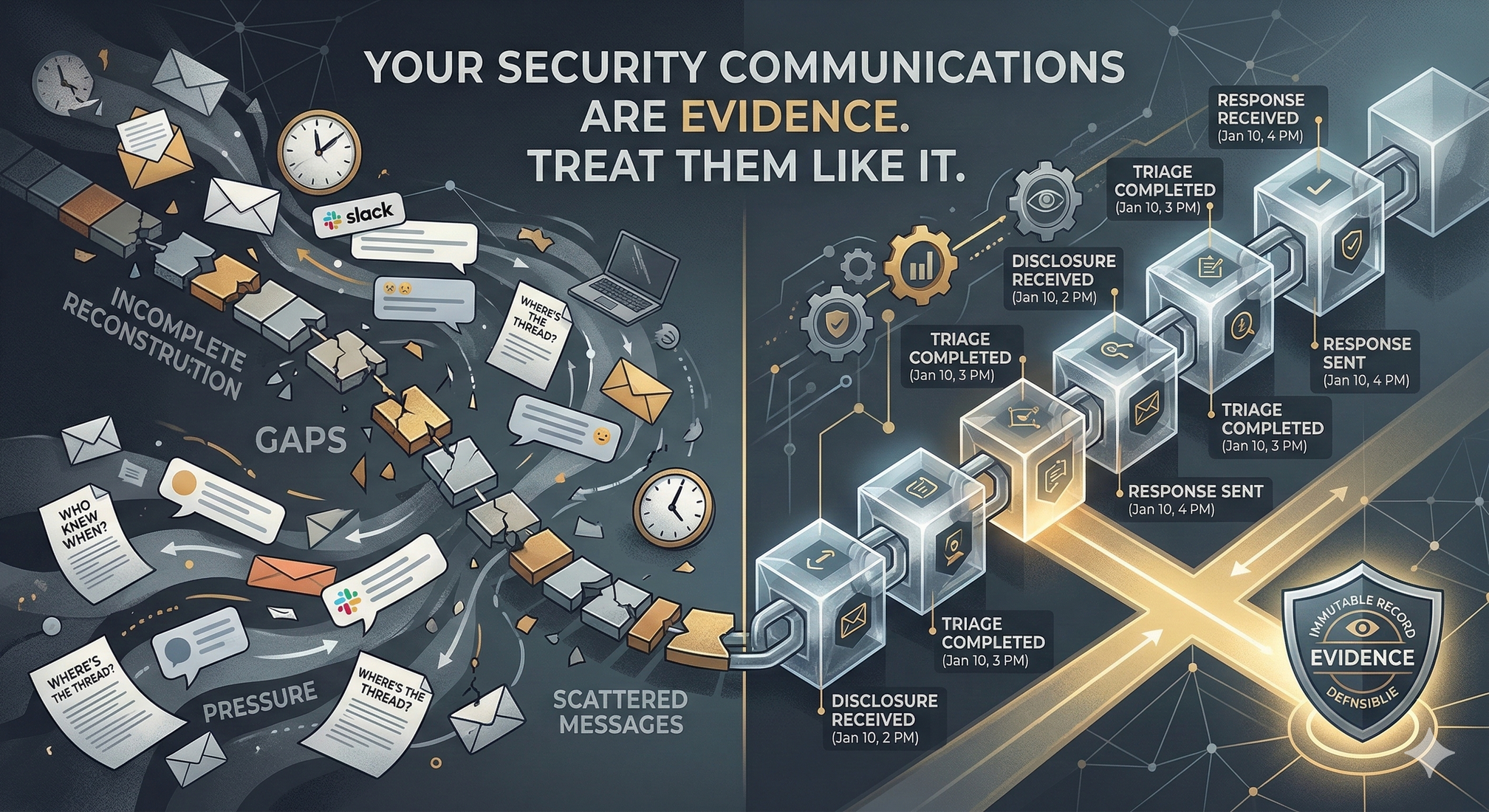
The breach gets confirmed on a Wednesday afternoon.
By Thursday morning, the questions start. From legal: when did we first learn about this? From the board: was this vulnerability previously reported to us? From the regulator: can you provide documentation of how this issue was handled when it was disclosed?
Your security team starts reconstructing the timeline.
They check email. Three people had relevant threads across four different inboxes. Some emails were forwarded, some were replied to from personal accounts, one critical exchange happened on a Friday afternoon when the usual person was out and someone else responded from their phone. The Slack thread where the actual triage discussion happened is buried somewhere in a channel that also contains lunch debates and off-topic memes. The engineer who wrote up the initial assessment left the company eight months ago. Their laptop was wiped.
By Friday, you have a partial picture. You have enough to tell a story. But you don’t have a record. You have a reconstruction — assembled under pressure, incomplete by definition, and very hard to defend if anyone decides to look closely.
This is the gap nobody talks about until it’s too late.
Security Communication Is Evidence. Treat It Like It.
Every organization invests in security controls. Firewalls, endpoint detection, vulnerability scanners, access management, SIEM. The assumption is that if something goes wrong, those controls either prevented it or caught it.
What most organizations haven’t thought through is what happens to the communications surrounding a security event. The emails. The disclosures. The questionnaire responses. The legal notices. The abuse reports. The vendor notifications.
Those communications are evidence. Not metaphorically — literally. In a regulatory investigation, a breach notification proceeding, a customer dispute, or litigation, the record of what was communicated, when, by whom, and what was done about it is material. Courts and regulators care deeply about the timeline. They want to know when you knew, what you did, and how you can prove it.
Most organizations can’t answer those questions cleanly. Not because they acted in bad faith. Because the communications were never treated as a system. They were treated as email.
The Incident Review Always Finds the Same Thing
Post-incident reviews are remarkably consistent in what they surface. The technical timeline — when the vulnerability was introduced, when it was exploited, what data was affected — usually comes together reasonably well. Log files are logs. They don’t move.
The communications timeline is always the problem.
A disclosure came in three months ago. Who handled it? The shared inbox shows it was opened, but there’s no record of what was done. Was it triaged? Was it forwarded to engineering? Was a response sent? If a response was sent, what did it say? Did it contain any representations about your security posture that are now awkward given what just happened?
A vendor filled out a security questionnaire six months ago and you attested that you had certain controls in place. Do those attestations still hold? Who reviewed them before they went out? Who authorized the response?
A legal notice arrived eight weeks ago. It was forwarded to counsel. Counsel sent a holding response. Then what? Is there a thread? Is there a file? Does anyone know the current status?
These gaps are not exotic. They show up in every incident review because they’re a predictable consequence of managing security communication the way most organizations do — as a distributed, informal, email-based process with no central record and no defined ownership.
The Notification Clock Is Already Running
Here’s the part that concentrates minds quickly when an incident occurs.
Under GDPR, you have 72 hours from discovery to notify the relevant supervisory authority. Under HIPAA, 60 days from discovery for the affected individuals and the Department of Health and Human Services. Under various state breach notification laws, timelines range from 30 to 90 days, with some as short as 72 hours for specific sectors.
The clock starts at discovery. Not at confirmation. Not when legal finishes their review. At discovery.
If a vulnerability report came into your security inbox six weeks ago that, in retrospect, described the attack vector that was just exploited — when did discovery occur? If the email was opened and not acted on, is that discovery? If it was forwarded and the forward was never replied to, is that discovery?
You do not want to be answering these questions from memory, under regulatory scrutiny, using a reconstructed timeline assembled from Slack and forwarded email threads.
You want a timestamped, unambiguous record showing exactly when each message was received, who saw it, what classification was applied, what actions were taken, and when each communication was sent. That record needs to exist before the incident. It needs to be maintained as a matter of routine, not assembled as a matter of emergency.
What an Audit Trail Actually Requires
“We have records” is not the same as “we have a defensible audit trail.”
A real audit trail for security communications has specific properties.
Immutability. The record reflects what actually happened, in sequence, and can’t be retroactively edited. Forwarded email threads don’t qualify — they can be modified, and their provenance is ambiguous. You need a system that logs actions as they happen.
Completeness. Every inbound message is captured. Not just the ones that seemed important at the time. Not just the ones that got a response. Every disclosure, every questionnaire, every legal notice, every abuse report — logged on arrival, regardless of what was done with it.
Attribution. Who did what. Who opened the message, who classified it, who responded, who approved the response. Named individuals, not shared accounts. If something went wrong, the record should show clearly where in the process it happened and who was responsible at that step.
Accessibility. When legal needs the file at 9pm on a Thursday, someone can pull it. Not “check with the person who set up the inbox” — pull it. A self-contained record of the complete interaction history, exportable on demand.
Most organizations can describe this kind of audit trail in their policies. Almost none have it in practice. The gap between the policy and the reality is exactly what gets exposed when something goes wrong.
This Isn’t About Preparing for Failure
There’s a version of this conversation that sounds like disaster planning — like the whole point is to be ready for the worst case. That’s not quite right.
Building a proper record of your security communications isn’t a pessimistic act. It’s what a mature security operation looks like. The same way you keep logs because logs are how you understand what’s happening, you keep records of security communications because those records are how you understand what you’ve committed to, what you’ve been told, and what you’ve done about it.
The audit trail also makes you faster. When a new vulnerability report comes in, you can check whether a similar issue was reported before. When a questionnaire asks about your incident response process, you can pull the actual record of how you’ve handled incidents, not write something from scratch. When a regulator asks how you manage disclosures, you can show them a system, not a story.
The record isn’t for the worst day. It’s for every day. The worst day is just when you’re most grateful it exists.
Build the Trail Before You Need It
The organizations that handle incidents cleanly — that get through regulatory scrutiny, maintain customer trust, and come out the other side with their credibility intact — aren’t the ones with the best PR. They’re the ones who can show their work.
They can produce the disclosure that came in, the timestamp it was received, the classification that was applied, the engineer it was routed to, the response that was sent, and the resolution that was reached. Clean. Documented. Defensible.
That record didn’t get built during the incident. It was built in the three years before it, one message at a time, by a team that treated their security inbox like the operational system it actually is.
You don’t get to decide when the incident happens. You do get to decide whether you’re ready for the questions that follow.
Start keeping the records now.
Every email, response, and action in Fortworx is automatically logged with a full audit trail — ready for compliance with GDPR, SOC 2, HIPAA, PCI DSS, and more. Start for free or book a demo.