Monday, May 18, 2026
DSAR: The Operator's Field Guide

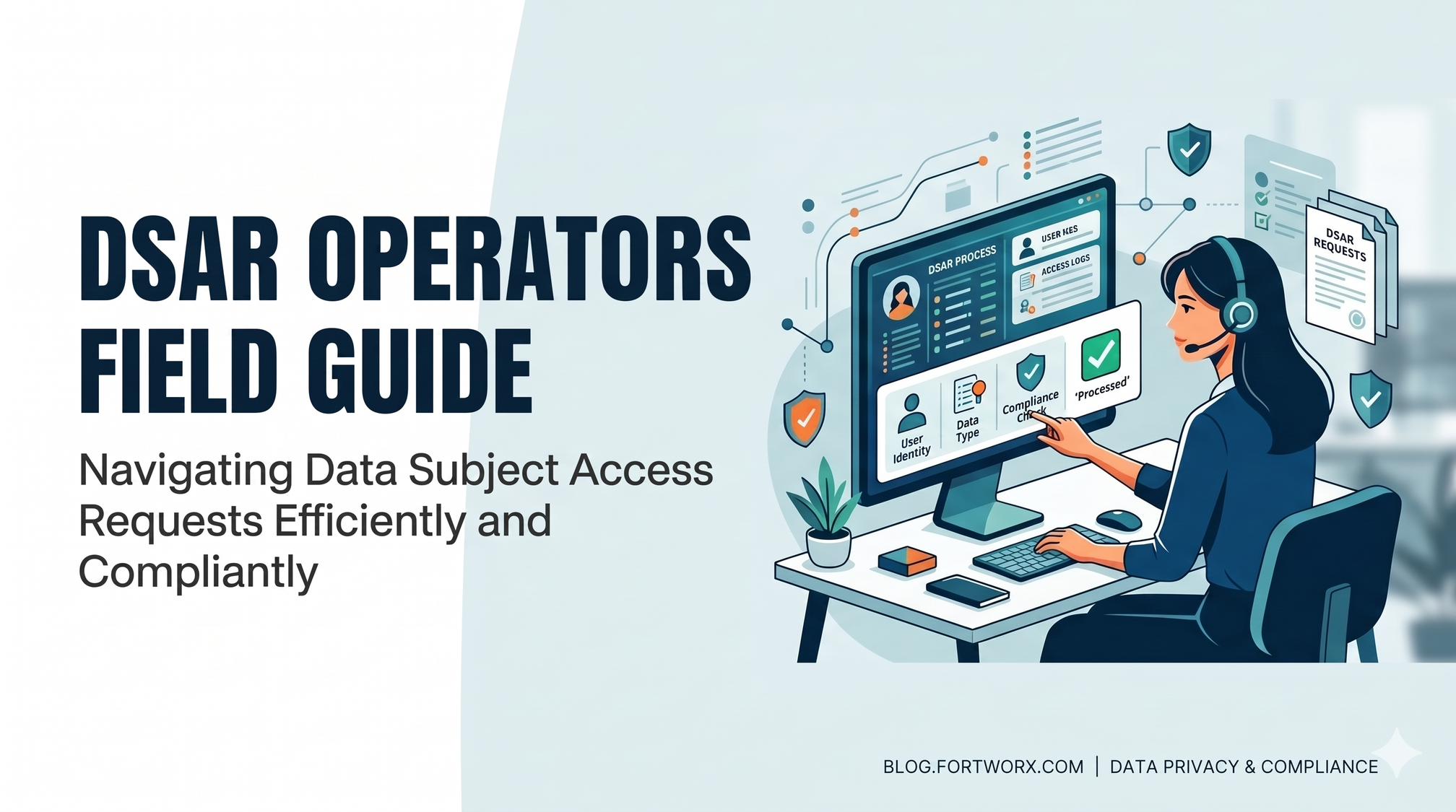
A data subject access request shows up in your inbox without warning, on a clock you didn't start, governed by a law you didn't write. You have 30 days. The lawyer who drafted it doesn't care that nobody on your team has handled one before.
This guide is for the person who owns that inbox.
What a DSAR actually is
A DSAR — data subject access request — is a request from an individual asking what personal data you hold about them, why you hold it, who you share it with, and demanding a copy. Depending on jurisdiction, the same mechanism also covers correction, deletion, portability, restriction of processing, and objection.
Different laws name it differently:
- GDPR (EU) — Article 15, "right of access by the data subject"
- UK GDPR / Data Protection Act 2018 — same right, post-Brexit
- CCPA / CPRA (California) — "right to know" (§1798.110), "right to delete" (§1798.105), "right to correct"
- Brazil LGPD, Quebec Law 25, India DPDP, Virginia VCDPA, Colorado CPA — and a growing list of US state laws
The mechanics differ. The principle does not. Someone asked for their data. You owe them an answer in writing, on a deadline, and you need to be able to prove you got it right.
The clock starts when the request arrives — not when you notice it
This is where most teams lose before they begin.
The GDPR gives you one month from the date of receipt to respond. You can extend by up to two months for complex or numerous requests, but you must tell the data subject within the first month that you're extending and explain why. CCPA gives you 45 days, extendable by another 45 with notice.
"Receipt" means the moment the request hit any channel you control. Not the moment your privacy team triaged it. Not the moment the ticket was assigned. If a DSAR sat in `support@` for nine days before someone routed it to `privacy@`, you have already burned nine days.
This is the single most common DSAR failure: the clock running in a channel that isn't being watched as a privacy channel.
Where DSARs actually come from
If you only watch the `/privacy-request` form on your marketing site, you will miss most of them.
Real DSARs arrive through:
- Support inboxes — `support@`, `help@`, customer chat widgets
- Security and abuse aliases — `security@`, `abuse@`, the same aliases your VDP feeds
- Legal letters — physical mail from solicitors representing the data subject
- Sales and account managers — a customer mentions it in passing on a call
- Social DMs — yes, really; regulator guidance treats a clear request as valid regardless of channel
- Subject access request forms — the one place you actually designed for it
The law doesn't require the requester to use a specific form, use the magic phrase "data subject access request," or even mention the relevant regulation. If a reasonable reader would understand the message as a request for personal data, it counts.
Practical consequence: every inbound channel that can receive personal communication is a potential DSAR channel, and the people staffing those channels need to recognize one when they see it.
The seven phases of a defensible DSAR
You don't need a 40-page playbook. You need seven phases, executed in order, every time.
1. Intake and logging
The first action on receipt: log the request. Timestamp, source channel, raw content, requester's stated identity. This single record is the anchor for the rest of the workflow and the document an auditor or regulator will ask for first.
Triage decisions to make immediately:
- Is this actually a DSAR, or something adjacent (a marketing opt-out, a deletion request, a complaint)?
- Which jurisdiction(s) apply? The requester's residence is one factor; where you process is another.
- Is the requester the data subject themselves, an authorized agent (CCPA permits this), or a third party with no standing?
Get this wrong and the rest of the workflow runs on bad inputs.
2. Identity verification
You cannot hand someone else's personal data to a stranger. You also cannot demand so much verification that you've effectively denied the request — both ICO and EDPB have guidance against over-verification.
Calibrate to the data sensitivity:
- For an account holder, authenticate through the existing account (logged-in session, OTP to verified email)
- For a non-account requester, ask for enough corroborating detail to establish a reasonable identity match — and document why what you asked for was proportionate
- For an authorized agent, you can require proof of authorization (signed permission, power of attorney) plus direct confirmation from the data subject
Record what you asked for, what you received, and the decision rationale. This is the single most-litigated step in DSAR disputes.
3. Scope assessment
The request says "all my personal data." What does that mean in your environment?
- Categories — account data, transaction history, support tickets, server logs, marketing event streams, derived analytics, third-party enrichment data, backup snapshots
- Time range — most laws give you the full retention window; some allow you to cap at a reasonable lookback (document the cap)
- Identifiers to search on — email, customer ID, phone, IPs associated with the account, device IDs, cookie IDs, anything that resolves to the same person
- Exemptions in play — legal privilege, ongoing investigation, third-party data, trade secrets, repeated or manifestly excessive requests
Exemptions matter. A request for "all communications about me" doesn't reach the email between your General Counsel and outside counsel discussing the request itself — but you have to know that, and document why, before you withhold it.
4. Collection and search
This is the operational nightmare.
Your data lives in: the production database, replicas, the data warehouse, S3 buckets, the CRM, the support tool, the marketing platform, the analytics platform, email logs, application logs, audit logs, backup snapshots, the BI cache, third-party processors' systems you've contractually bound, and whatever new SaaS tool a team adopted last quarter.
Every one of those is a search target. Every one of them returns data in a different format with different identifier conventions. Stitching it together by hand is where small teams burn out and where large teams add headcount.
Things to actually do here:
- Maintain a current data map — a list of every system that processes personal data and the identifier you'd search it on. This is what GDPR Article 30 records are for, even though most teams treat them as audit theatre
- Run one identifier resolution pass at the start to translate the requester's known identifiers into every ID you'll need downstream
- Search backups only if you'd be able to restore from them; data that's effectively unrecoverable is a separate exemption conversation
- Capture what you searched and what you found, not just the result — an auditor distinguishes a clean negative from a system you forgot to check
5. Review and redaction
Raw output is rarely shippable.
You'll find:
- Third-party personal data tangled with the requester's data (the support ticket where Alice complained about Bob)
- Internal commentary that's the company's data, not the requester's (a CSM note that reads "this customer is high-risk for churn")
- Free-text fields with PII for other people (an email that copies five colleagues)
- Encrypted blobs you'll need to decide whether to decrypt or treat as inaccessible
Redaction policy needs to be written down. "Redact other individuals' personal data unless they consent" is the default rule under GDPR. "Release internal commentary only where it constitutes the requester's personal data" is a judgment call you should make consistently.
Inconsistency between requests is the second-most-common audit finding, behind missed deadlines.
6. Response delivery
Send the response in a structured, commonly used format. CSV or JSON for tabular data, PDF for narrative records. GDPR Article 12(1) requires "concise, transparent, intelligible and easily accessible form" — meaning a 4 GB ZIP of raw log lines is not a response, even if it technically contains the data.
Include:
- A cover letter explaining what was searched, what's enclosed, what was withheld, and the legal basis for each withholding
- Contact information for follow-up questions and the right of complaint to a supervisory authority
- A signed checksum or hash of the delivered archive — useful if the requester later disputes what was sent
Deliver through a channel that can be authenticated. Sending a ZIP of personal data to an unverified email address is its own data breach.
7. Audit trail
The deliverable to the regulator is not the response to the data subject. It's the trail behind it.
A defensible audit trail reconstructs, on demand:
- When the request arrived, through which channel, in what wording
- How identity was verified and why that level was proportionate
- The scope decision and what was in/out
- Every system searched, the search terms used, and the result
- The redaction decisions made and the policy that drove them
- Who reviewed, who approved, who delivered
- The exact artefact delivered, with hash
- Any extension granted, when notice was given, and why
If any of that is missing, you don't have a defence — you have a hope.
Exemptions you'll wish you'd known about
The right of access is not absolute. The exemptions are jurisdiction-specific, but they cluster:
- Third-party data — you don't have to release personal data about other people unless they consent or it's reasonable to disclose
- Legal privilege — communications with legal counsel about the request itself
- Ongoing investigations — including law-enforcement requests and active fraud cases
- Trade secrets and IP — the algorithm that scored the requester is not the requester's personal data, though the score itself usually is
- Manifestly unfounded or excessive requests — repeat requests at short intervals, requests clearly intended to harass, requests with no plausible identity basis
- National security and crime prevention — narrow, jurisdiction-specific, document everything
Two things to remember: you must respond something even when you're applying an exemption (silence is not an option), and you must document the basis for the exemption at the time of the decision, not reconstructed later.
What breaks at scale
Manual DSAR handling works until it doesn't. The wall is usually around 15–20 requests a month. The failure modes:
- Missed clocks — multiple requests in flight, no central calendar, the 30-day clock on request #7 expires while the team is finishing request #3
- Inconsistent decisions — the same scope question gets answered three different ways across three different requests
- Lost audit trail — the search was done in someone's terminal, the redaction in their copy of Word, the response sent from their personal mail-merge tool, and they left the company
- Identity verification drift — what counted as sufficient ID for one requester didn't for another, and a regulator notices
- Channel blindness — DSARs arriving via `support@` never get classified as DSARs, and the clock expires before anyone notices
The signal that you've outgrown ad-hoc handling is not request volume. It's the moment you can't answer "where are we on the Acme request?" in under a minute, with full timeline, scope, search status, and clock.
What "defensible" actually means
Defensibility is the bar, not perfection. You will sometimes miss things. You will sometimes apply an exemption a regulator disagrees with. You will occasionally release something you shouldn't have, or withhold something you should have released.
What separates a survivable DSAR programme from an unsurvivable one is whether, when any of that happens, you can show:
- You had a written process
- You followed the process
- You documented the decisions you made and why
- You acted in good faith and within stated timelines
Regulators don't expect you to be infallible. They expect you to be auditable. The two are different, and the second one is achievable.
Where Fortworx fits
Fortworx centralises every inbound DSAR — whatever channel it arrived through — into a single workspace with the audit trail built in. Intake, identity verification, scope, search coordination, redaction review, delivery, and the timeline behind all of it live in one place. The clock starts the moment the request hits any inbox you connect, not the moment someone notices.
If you're handling DSARs in spreadsheets and shared inboxes today, that's the gap we close.